


Seeing Babies, Strengthening Relationships: How NBO and VIG Work Better Together.
By Inge Nickell, Director, Brazelton Centre UK & Hilary Kennedy, Joint CEO, AVIGuk
At a time of increasing demand on early years services and growing awareness of the importance of infant mental health, there is understandable interest in finding approaches that make the greatest difference for babies and families.
Across maternity services, health visiting, family hubs and infant mental health teams, practitioners and commissioners are rightly asking what works and how we can best support families in the earliest years of life.
Yet perhaps the most important question is often the simplest: what do babies need?
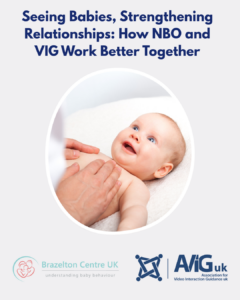
Babies communicate from the moment they are born. Through their movements, facial expressions, sleep patterns, cries, behaviours and cues, they continually tell us something about their experience. One of the most important tasks for parents and professionals is learning to recognise, understand and respond to those communications.
When this happens, something powerful occurs. Parents grow in confidence, babies experience more responsive care, and relationships begin to flourish. These early relationships provide the foundation for emotional wellbeing, healthy development and future learning.
This shared focus on understanding the baby’s perspective sits at the heart of both the Newborn Behavioural Observations (NBO) system and Video Interaction Guidance (VIG). While they use different methods, they share a common purpose: helping adults to notice, understand, and respond to the emerging signals from the baby in front of them. Babies are born ready to communicate.
Rather than asking which approach is best, a more helpful question may be: how can these approaches work together to strengthen relationships and support families?
NBO and VIG have much in common. Both are strengths-based, relationship-focused approaches that help adults see and appreciate what babies are communicating. Both create opportunities for reflection, curiosity and connection. Both recognise that parents are the experts on their own children and seek to build confidence rather than provide instruction.
Where they differ is in how they make the baby’s voice visible.
In the NBO, the practitioner and parent observe the baby together in real time. Through shared observation of the baby’s behaviour, responses and cues, parents are supported to understand what their baby may be communicating and how they can respond. These moments often create powerful
Opportunities for parents and babies to truly “meet” one another, sometimes for the very first time. The baby’s strengths, preferences and emerging competencies become visible, helping parents feel more connected and confident in their relationship.
VIG uses a different route to reach a similar destination. Through video recordings of everyday interactions, practitioners help parents identify and enjoy successful moments of communication and connection with their baby. By watching and reflecting on these “attuned moments”, parents are able to see their own strengths and recognise the attuned ways they are already responding to their baby.
Where the NBO helps parents discover their baby through observation, VIG helps parents discover themselves in relationship with their baby through video reflection.
Together, these complementary perspectives can provide a richer understanding of the parent-infant relationship.
The strength of the NBO lies in its ability to make the newborn baby an active participant in the conversation. By slowing down and observing the baby together, parents often begin to notice signals and abilities they may previously have missed.
VIG extends this process by creating a reflective space where parents can revisit interactions, slow them down and see evidence of their own sensitive responses. Parents frequently discover strengths they had not recognised in themselves, helping to build confidence and reinforce positive patterns of interaction.
Both approaches are deeply empowering. Rather than focusing on problems or deficits, they highlight existing strengths and capacities within both babies and parents. Importantly, they can be particularly powerful when used together.
Practitioners trained in both NBO and VIG often report that the approaches naturally complement one another. The detailed understanding of newborn communication developed through NBO can enrich the microanalysis involved in VIG, enabling practitioners to notice subtle infant cues, signals and attempts at communication that might otherwise go unseen. Equally, the reflective process within VIG can deepen and sustain the insights first gained through shared observation in the NBO. In this way, each approach enhances the other.
Many families benefit enormously from early, relationship-based support that helps them understand their baby and gain confidence in their parenting. The NBO is particularly valuable in these earliest days and weeks, offering an accessible and universal way to strengthen parent-infant relationships from the start.
Some families, however, may need additional opportunities for reflection and support as they navigate more complex circumstances, including parental mental health difficulties, trauma, relationship challenges or other pressures.
This is where VIG can make a significant contribution. Through a series of guided video feedback sessions, parents can explore moments of connection and build deeper insight into their relationship with their baby over time. This does not represent a different goal. Rather, it reflects different levels of support along the same relationship-focused pathway.
Seen in this light, NBO and VIG are not competing interventions. They are complementary approaches that can support families at different points in their journey and in different ways according to need.
Families do not experience services in separate categories. Their journey through pregnancy, birth and infancy often involves multiple professionals, teams and organisations.
The most effective systems therefore are not those that champion one intervention above another. They are those that create opportunities for different approaches to work together around a shared purpose.
When practitioners can draw upon complementary methods, families are more likely to receive the right support at the right time. When services build bridges between universal and specialist provision, support becomes more connected and responsive. And when everybody remains focused on understanding the baby’s experience, interventions become less about programmes and more about relationships.
The recent dialogue between NBO and VIG practitioners highlighted exactly this possibility. It demonstrated that meaningful collaboration is not only possible but beneficial.
Perhaps the most important message from the conversation is that babies benefit most when we move beyond debates about which intervention should “win”. Both NBO and VIG help adults see babies more clearly. Both strengthen parental confidence. Both promote sensitive, responsive relationships that support healthy development.
The NBO does this through shared observation of the baby, creating moments of discovery and connection between parent and infant. VIG does this through video reflection, helping parents recognise and build upon their own attuned responses.
Different methods. Shared values. Common goals.
By bringing these approaches together, we can create a more connected pathway of support that helps parents understand their babies, recognise their own strengths and build secure, joyful relationships from the very beginning.
Because ultimately the question is not whether NBO or VIG is better. The question is how we can use the strengths of both approaches to be better for babies, together.